Cross-institution Research Collaboration

When do lizards stop sleeping in the trees?

Green anoles sleep exposed on leaves and twigs all summer long — then vanish in winter. We're building a network of collaborators to track Anolis carolinensis sleeping habits across their range. We want to know when green anoles change their sleeping perch in an effort to understand thermal adaptation at range edges.

Join the network
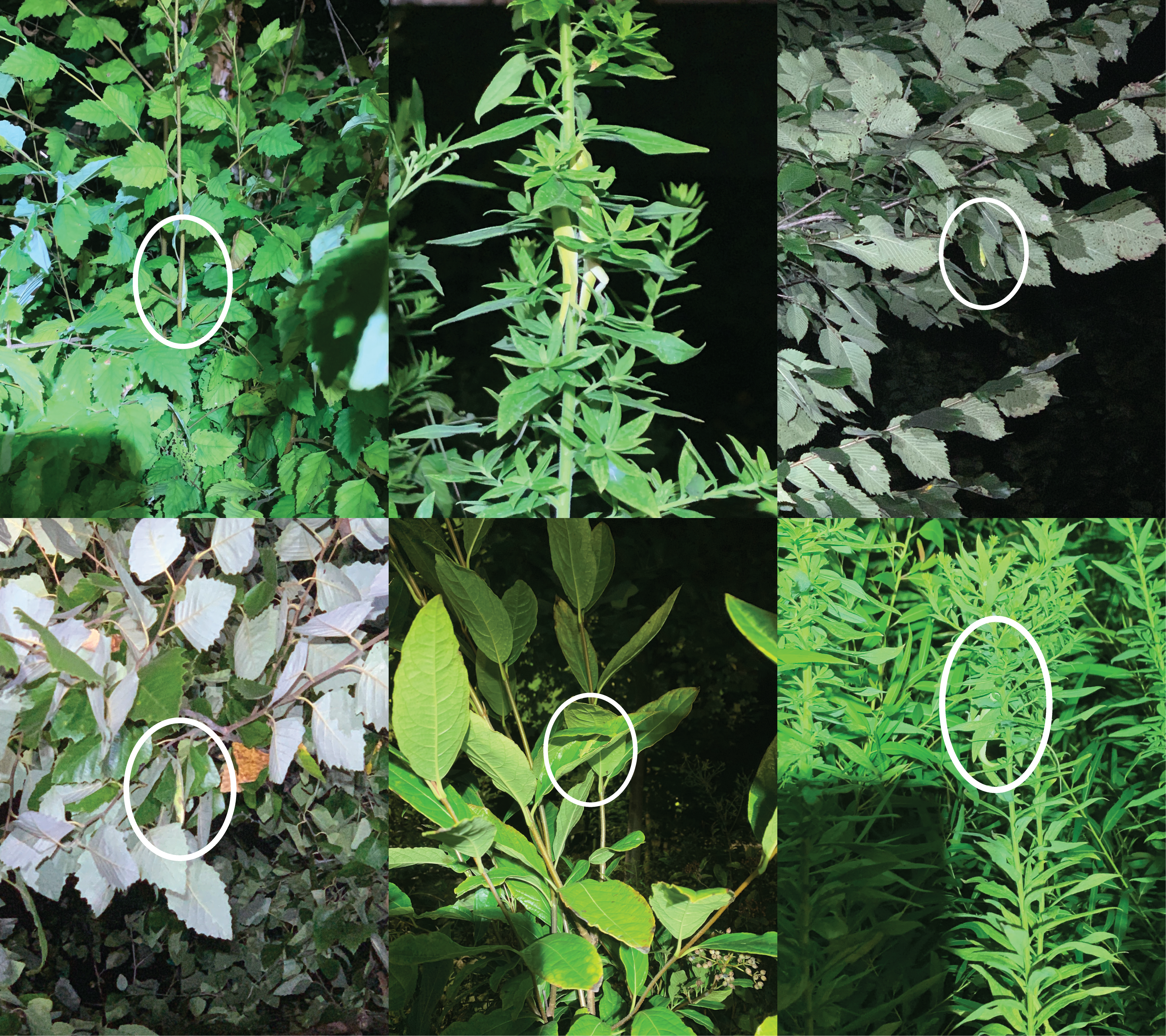
Sleeping anoles
Fig. 1 — Green anoles sleeping on exposed vegetation during nighttime transect surveys.
Start time 1 hr after sunset each survey night
Transect length 500–1000m both sides surveyed simultaneously
Frequency Weekly or bi-weekly throughout season

A nocturnal window into thermal limits

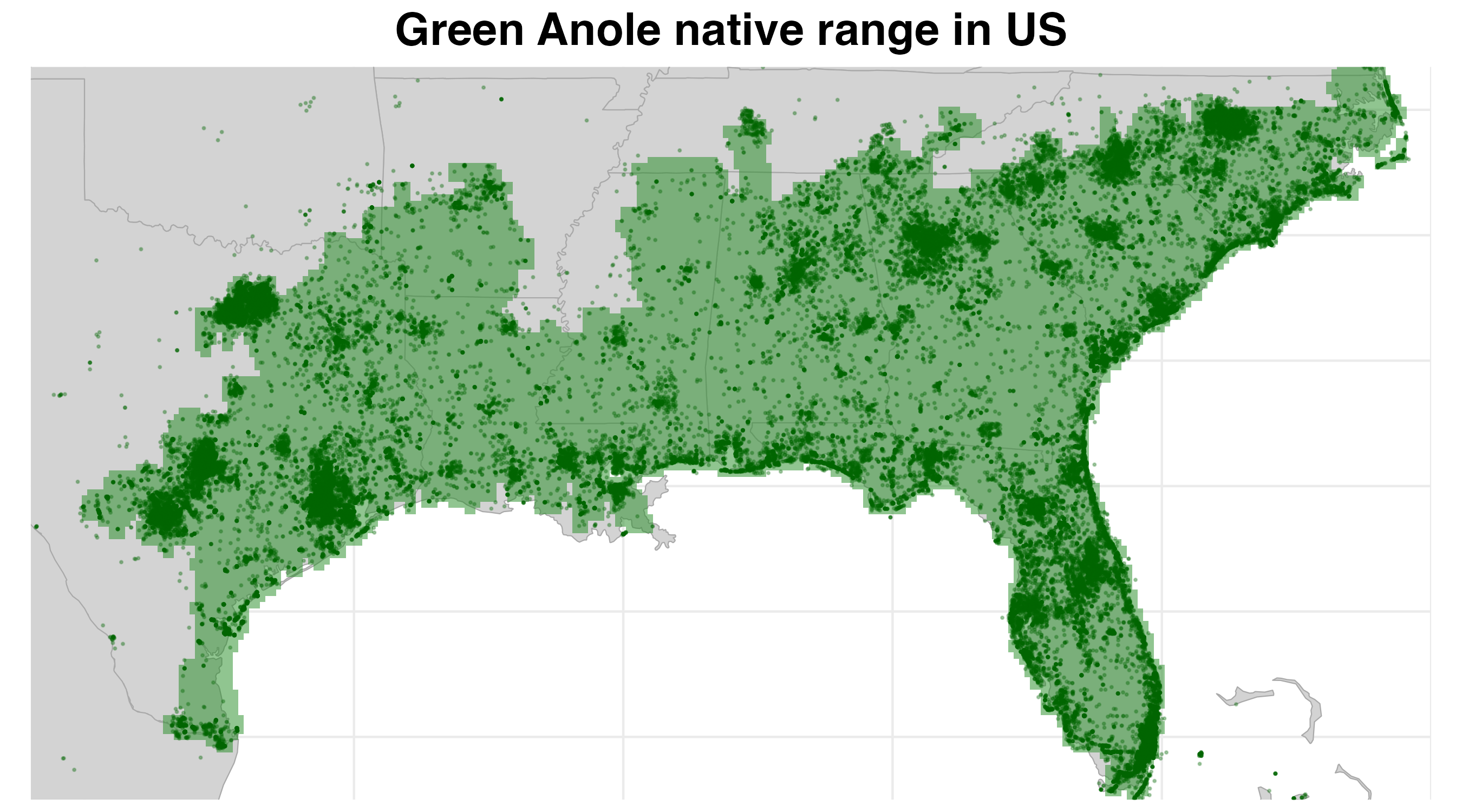
Range map of Anolis carolinensis
Fig. 2 — Geographic range of Anolis carolinensis across the southeastern United States. (GBIF accessed July 2, 2025)
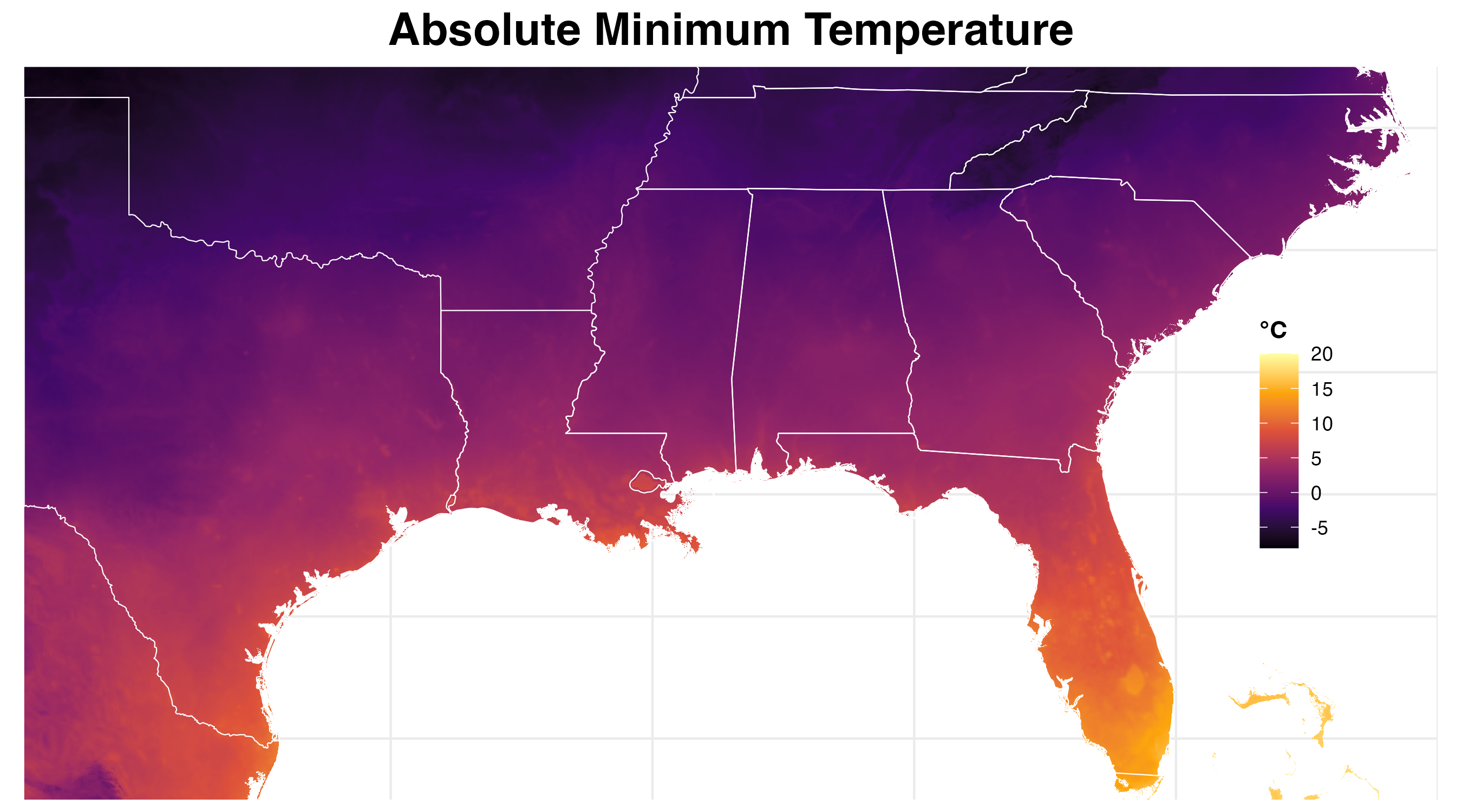
Winter temperature map
Fig. 3 — Minimum annual temperatures across the green anole's range. (WorldClim v2.1 BIO6)

Anoles commonly sleep exposed on leaves and twigs so they can sense approaching predators — a snake slinking down a branch triggers a drop to the ground and escape. This survival strategy is very effective in warm tropical environments, but in temperate climates, sleeping exposed can be risky. If low overnight temperatures dip below the lizard's cold tolerance limit, it risks death.

Despite these challenges, the green anole (Anolis carolinensis), an ancestrally tropical lizard, lives as far north as Virginia. In the spring and summer, anoles can be found sleeping out on leaf tips after dark — but in the winter, they disappear completely in temperate regions. Where do they go? When do they switch their sleeping behavior?

To answer these questions, we conduct weekly evening spotlight surveys along a standardized transect. By tracking lizard abundance, perch characteristics, and air temperature throughout the seasonal transition we can pinpoint when anoles shift their behavior and begin seeking nocturnal refuges. We are excited to collaborate across the green anole's range to test for local adaptation in thermal limits or seasonal behavior patterns.

"In warm months it is common to see them sleeping exposed out on leaves, but they disappear completely in the winter. Where do they go? When does the switch happen? Let's find out!"

🌙
Timing of behavioral shift At what air temperature do green anoles stop sleeping exposed? Is there a sharp threshold or a gradual transition?
🌡️
Thermal exposure at night How cold does it actually get at the perch heights where lizards sleep, versus on the ground, or in the leaf litter? iButton loggers capture this directly.
🍃
Perch selection Do lizards shift perch height, perch type, or microhabitat as temperatures cool — before disappearing entirely?
🗺️
Geographic variation Does the behavioral switch happen at the same temperature across the range, or do northern populations have different thresholds?
Example Transect

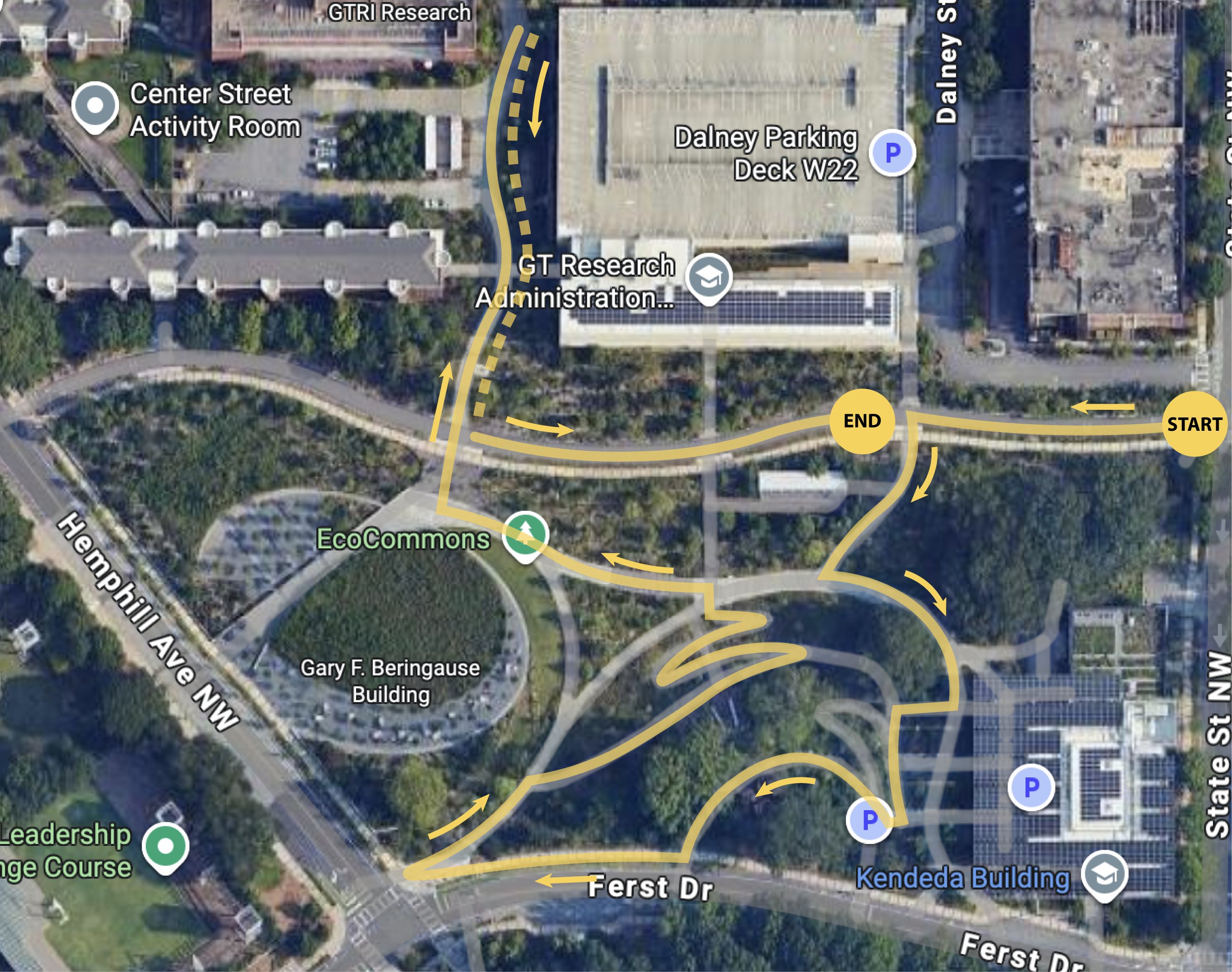
Our study site at Georgia Tech is a 7-acre natural area on campus where cultivation of native plants is prioritized and trails provide easy access throughout. Green anoles are abundant and obvious on sunny days. Your institution's transect should follow similar principles.

Aerial map of the GT EcoCommons study site showing the survey transect route marked in yellow, starting near State Street NW and ending near the GTRI Research area, passing through the EcoCommons natural area.

Fig. 4 — Georgia Tech study site and transect. Dotted line segment is not re-surveyed (surveyed outbound only).

Site area 5–10 acres Natural area with lots of vegetation. Repeatable and easy to navigate.
Transect length 500–1000 m Both sides surveyed simultaneously by the observer team
Survey duration 1 hour Walking the full transect at a steady pace with all observers scanning
⚠ Follow the transect exactly Staying on route is essential for quantifying search effort and ensuring lizards are not re-sampled. Any deviation should be noted on the datasheet.
🏛 Your institution's site We recommend surveying potential sites on warm sunny days to confirm green anoles are present. These lizards like well-vegetated areas with ample edge habitat.

As ectotherms, lizards maintain body temperature by behaviorally thermoregulating — basking in the sun, escaping to thermally-stable refugia. As air temperatures drop during the cooler months, green anoles increasingly abandon their arboreal sleeping positions in favor of more thermally buffered refuges. This behavioral shift is the central focus of our weekly surveys. Tracking the timing and magnitude of this transition across sites gives us insight into inter-population variability in response to temperature and to probe whether thermal behavioral thresholds differ across the species' range.

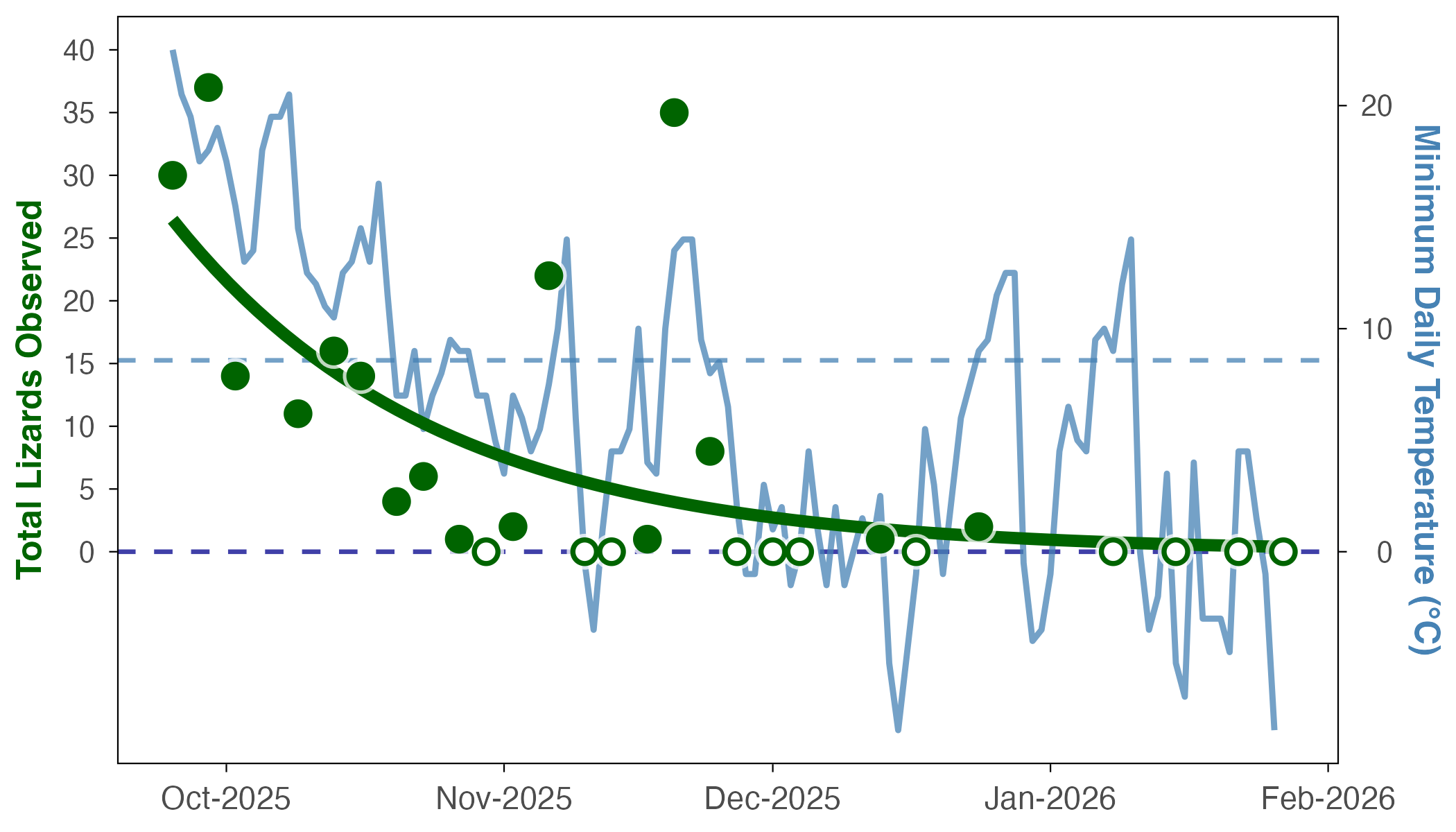
The image to the right shows the total number of lizards encountered during a survey night. Pairing these data with concurrerent air temperature logging illustrates that sleeping behavior is closely tied to minimum air temperature. Expanding these data across the Anolis carolinensis range could reveal local adaptation.

Fig. 5 — Total green anoles observed during nocturnal surveys at the Georgia Tech study site. Each point represents a single survey night, hollow circles indicate no lizards were observed. Minimum daily air temperature recorded by iButtons in blue. Dashed lines demarcate physiological thermal minimum (light blue) and freezing (dark blue).

01

Submit the Sleeping Lizard Interest form

After submission, we will meet to discuss designing the perfect transect, when your group should start surveying, how to conduct surveys, and assign your group a Site ID and related materials. This conversation ensures consistent data collection across the region.

Submit Interest Form
02

Identify a study site

Select a semi-natural area with reliable green anole populations and consistent evening access throughout the year. Map a 500–1000m transect around the area, including known green anole sleeping sites.

See our example site
03

Read the protocol

All surveyors must be familiar with the full protocol before the first survey. Pay particular attention to the data collection section — consistent recording of perch type, height, and width is essential for data integrity.

Read protocol
04

Register your Surveyors

We welcome surveyors of all experience levels, but to better account for detection probability, we require that each participant submit the following form before conducting a Sleeping Lizard Survey.

Submit Participant Survey
05

Gather equipment

Core gear is simple: datasheets, clipboard, tape measure, and headlamps or flashlights. Optional temperature data is highly valuable — iButton loggers and a thermocouple allow site-specific microclimate characterization beyond what weather stations provide.

View full equipment list
06

Start surveying & submit data

Enter data into the shared network spreadsheet after each survey. Back up your datasheets — scan or photograph them and store in at least two locations. The lead team reviews submissions on a rolling basis and will flag any issues.

View materials

Equipment

Evening surveys require minimal gear. Temperature data collection is strongly encouraged but not required to participate.

Required

Datasheet (printed, one per survey)
Writing implement (pencil recommended)
Clipboard
Tape measure
Headlamp and/or flashlight (each surveyor)

Optional (strongly recommended)

iButtons, HOBOs, or other temperature data logger
Lizard pole (for capture)
Thermocouple with thin wire probe (for body temperature)
About iButton temperature loggers iButtons are deployed in paired sets (to account for failure rates) inside painted copper pipes (2cm diameter × 7cm), sealed with corks. Tree loggers are zip-tied to branches ~2m off the ground. Leaf litter loggers are buried in litter or pine straw deep enough to cover the tube fully. Rock loggers go under rocks or in crevices where they can be reliably retrieved. Deployment is optional but provides site-specific thermal data that weather station records cannot replace. Contact us for deployment guidance.

Step-by-step survey protocol

All surveys must follow this protocol. Any deviations — weather, visibility, personnel — should be recorded in the datasheet and flagged to the lead team.

Timing

Survey timing & duration

Surveys occur in the evening, 1 hour after sunset. This timing ensures lizards are settled into their sleeping spots, won't be disturbed by surveyors, and are detectable by spotlight.

🌇 Start: 1 hour after sunset ⏱ Duration: 1 hour

The survey ends when the team reaches the end of the transect — do not turn back early. Record the end time on the datasheet when you arrive at the end point.

Step 1

Record all starting information

Before walking, fill in the header block on the datasheet. These fields are required — an incomplete header means the survey cannot be entered into the database.

Survey date YYYY-MM-DD format
Start time 24:00 format
Starting Tair Air temperature in °C (if measured)
Surveyors Initials of every person on the survey
Step 2

Walk the transect — begin looking for lizards

All observers should walk together and survey both sides of the transect simultaneously, scanning vegetation with headlamps and flashlights. Check leaves, twigs, branches, trunks, rocks, and roots.

  • Both sides of the transect are surveyed at the same time — do not split up
  • Follow the mapped transect exactly — do not cut corners or extend into unsurveyed area
  • Stop walking to record each encounter
💡

Green anoles sleeping on leaves often appear pale or white-ish under a headlamp — quite different from their daytime coloration. Look for this characteristic at the tips of branches and on the upper surfaces of leaves.

Step 3

When a lizard is spotted — always record

For every lizard detected, record the following fields on the datasheet before approaching or attempting capture. Movement toward the lizard changes behavior and may cause it to flee.

Time found 24:00 format
Spotted by Initials of the observer who detected it
Perch type Branch · Trunk · Leaf · Ground · Rock · Root
Perch H / W Height and width of perch in cm
Notes Any observations relevant to that individual
Step 3b

If the lizard is collected — additional measurements

Capture is optional and requires IACUC approval at your institution. If a lizard is captured, measure and record body temperature as quickly as safely possible.

  • Measure body temperature (Tbody) cloacally using a thermocouple with a thin wire probe
  • Hold the lizard by the head to prevent hand-to-lizard heat transfer that could skew Tbody
  • Record air temperature (Tair) at the moment of measurement
🚫

Do NOT capture every lizard observed. Excessive handling may cause lizards to change their sleeping habits to avoid detection. We recommend capturing a maximum of 5 lizards per survey for body temperature sampling.

Step 4

Complete the survey & record ending time and air temperature

Continue until the end of the transect. Fill in the final data fields before leaving the site.

End time 24:00 format
Ending Tair Air temperature (°C) at survey end
Step 5

Back up your data

Lost survey data is unrecoverable! Following every survey:

  • Photograph or scan the completed datasheet
  • Enter the data into the shared network spreadsheet
  • Store the original paper datasheet in a designated binder at your institution
  • Upload the scanned/photographed copy to the shared drive folder for your site
📋

Ensure data is copied and recorded in multiple locations to prevent data loss. The paper datasheet, a scan, and the shared spreadsheet are three independent backups — maintain all three.

Materials for participating teams

All documents are versioned — check the date before each field season and use the most current version.

📊

Network data spreadsheet

Each site will receive a unique Google Sheet for data entry. This will be created and shared when your institution joins the project. Request via the Interest form.

Submit Interest Form
📋

Field datasheet (printable)

Two-sided PDF datasheet for recording survey information. Print one copy per survey night. Current version: September 2025.

Download PDF
📄

Survey protocol

The full protocol document, including project overview, equipment list, study site guidance, iButton deployment instructions, and complete data collection procedure. Read before your first survey.

Download PDF
🌡️

Stationary temperature loggers

We deploy iButton or HOBO temperature loggers across the site in three different treatments: tree branch, leaf litter, and under cover such as a rock or log. Reach out directly for detailed guidance.

Visit HOBO Website
🗺️

Example transect map

High-resolution version of the Georgia Tech transect map for reference.

Download image
📝

IACUC protocol template

Depending on whether your team intends to capture lizards, your institution may require IACUC approval. We provide a template based on our approved GT protocol. Your coordinator can adapt it for submission to your institution.

Download .docx

Get in touch

We're excited for you to join the Sleeping Lizard project. Below are quick links for submitting the necessary forms or emailing us directly.

Join the network

We welcome collaborators from any institution with green anole populations nearby — grad students, postdocs, faculty, and herpetology clubs are all encouraged to join.

Submit Interest Form

Register surveyors

Already collaborating and ready to get your group into the field? Have each of your particpants fill out this form. Must have an active Site ID to proceed.

Submit Participant Form

General inquiries

Have a question about the project, protocol, date entry, or other? Reach out and we'll get back to you.

Contact us

Project Coordinators

Please prioritize the above links for project communication. For urgent field questions, text is fastest.

Profile photo

Taylor L. Cooper

PhD Student
Georgia Institute of Technology
Profile photo

James T. Stroud

Principle Investigator
Georgia Institute of Technology